View by Topic
Recent Articles
-
 TMDL Trump Executive Order – Why the Chesapeake Bay “Pollution Diet” Remains IntactSaturday, October 3rd, 2026
 -
 Maryland’s Packaging EPR Program Moves From Law to RealitySaturday, September 26th, 2026
 -
 Exposomics – The New Environmental Risk You Have Not Heard AboutSaturday, September 19th, 2026
 -
 Clean Water Isn’t a Constitutional Right? Fifth Circuit Says NoSaturday, September 12th, 2026
 -
 The Air We Breathe – Indoor Air Quality Is Becoming a Real Estate IssueSaturday, September 5th, 2026
View by Month/Year
“Green Building Law Update” Headlines
Recent Articles & News from
Stuart Kaplow’s blog
at GreenBuildingLawUpdate.com
Subscribe to the Green Building Law Update!
Stuart Kaplow brings his expertise and extensive experience to the table with his unique digital publication, "Green Building Law Update". Subscribers receive regular updates to keep them informed about important issues surrounding Environmental Law, Green Building & Real Estate Law, as well as the emerging demand for Environmental Social Governance (ESG).
Get fresh content through the lense of Stuart Kaplow's cutting-edge expertise, innovative commentary and insider perspective. Don't miss another issue! Subscribe below.
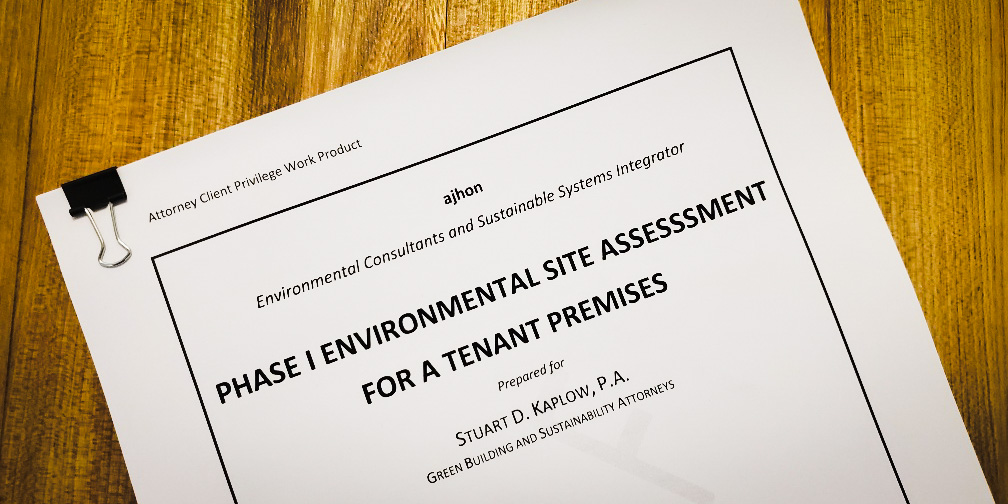
Phase l Assessments for Tenants are the Hottest Environmental Issue in 2020
The hottest environmental topic for business in 2020, as a result of an amendment to the Superfund law for the first time making clear that tenants can qualify as bona fide prospective purchasers, protected from cleanup costs from the presence of hazardous substances on a property, is prospective tenants are now ordering Phase l Environmental Site Assessments to take advantage of the liability protections in the new law.
Buried in the more than 800 page Consolidated Appropriations Act signed on March 23, 2018 was Division N, the ‘‘Brownfields Utilization, Investment, and Local Development Act of 2018’’ (the BUILD Act).
The Comprehensive Environmental Response, Compensation, and Liability Act of 1980 (CERCLA, commonly referred to as Superfund), 42 U.S.C. § 9601 et seq., provides an important liability protection, including from cleanup costs, for parties who qualify as bona fide prospective purchasers (BFPPs).
The potential applicability of the BFPP protection to a tenant who leases contaminated or formerly contaminated real estate has been the subject of debate for the decades since the CERCLA’s enactment. The cases interpreting CERCLA make clear that the mere execution of a lease does not necessarily make a tenant liable as an owner or operator under the law. But courts have acknowledged uncertainty regarding the potential liability of tenants under CERCLA including because a tenant may be an operator of the property as well as a responsible person, but tenants had previously lacked any express protection in the Superfund laws. A prospective tenant may now to seek BFPP treatment in the event of a future federal CERCLA cleanup action at the leased property or simply to ensure appropriate environmental stewardship of the property.
Such is a dramatically large issue with the economic contribution of real estate to the U.S. economy, when in any given year the vast majority of real estate transactions are leases and not contracts of sale. In 2020, an increasingly large number of prospective tenants, from commercial banks to sports apparel retailers and the defense industry are actively seeking protection from existing contamination before signing leases.
In 2002, as part of the Small Business Liability Relief and Brownfields Revitalization Act, the BFPP definition was amended to include the parenthetical phrase “(or a tenant of a person)” in the description of who can claim the BFPP defense, but there was no other direction on the treatment of tenants.
EPA then issued guidance in 2012 on the treatment of tenants as BFPPs, providing that a tenant could only derive it BFPP status through the property owner, and that status was limited to “so long as the owner maintains its BFPP status.” So while instructive, it provided little, if any, comfort to tenants.
This 2018 BUILD Act addresses the uncertainty dating to 1980, by amending CERCLA § 101(40) including by in subclause (II), by inserting ‘‘, by a tenancy, by the instruments by which a leasehold interest in the facility is created,’’ ..
And in that subsection, the term “bona fide prospective purchaser” has been amended to mean,
(ii) a person who (I) who acquires a leasehold interest in the facility after January 11, 2002; (II) who establishes by a preponderance of the evidence that the leasehold interest is not designed to avoid liability under this Act by any person; and ..”
Which has the macro effect of increasing the value of many commercial and industrial properties making reuse viable, obviating one of the longstanding criticisms of CERCLA, that the law limits urban redevelopment across America, and the micro effect of mitigating a tenant’s risk in an individual leasehold, by allowing a tenant to avoid CERCLA liability by any of the following three means:
One, establishing the landlord is a BFPP because that landlord completed the “all appropriate inquiries” as required by federal law (including with a Phase I ESA); or two, establishing that the landlord completed all appropriate inquiries, but later failed either with compliance or to complete additional requirements; or three, establish the tenant itself, as the BFPP, by completing all appropriate inquiries prior to acquiring the leasehold interest and maintaining compliance with the additional requirements, if any.
A tenant can now assert, without having to rely on the landlord’s status, the innocent landowner defense being protected from CERCLA liability including cleanup costs from the presence of a hazardous substances on the property.
In this new decade when cursed energy is “out” and dark energy is “in” Phase I ESAs ordered by prospective tenants are in.
As a pendent matter, when a Phase I ESA report exists, it may now as a result of the 2018 Build Act be material information, under state law, that a real estate broker is obligated to disclose to a prospective tenant.
Concomitantly, should the Phase I ESA reveal a recognized environmental condition, a tenant could seek protection as a “inculpable person” not liable for existing contamination under state Brownfield laws.
In 2020, prospective tenants in commercial and industrial properties are now ordering a Phase I Environmental Site Assessment.
About the Author: Stuart Kaplow