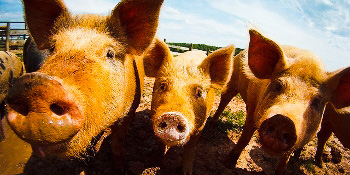
Last week a jury in federal court awarded more than $470 million to six people who live from one-third of a mile to one mile away from a hog farm, run by Murphy Brown an affiliate of Smithfield Foods, in a rural patch of Pender County, North Carolina.
The lawsuit is the third to go to verdict of more than two dozen cases pending in North Carolina. In April another federal jury award ten families in Bladen County $50 Million. And then in June a different jury awarded $25 million to a couple in Duplin County.
Of note, the most recent verdict is against two farms that have the largest ‘humanely raised’ hog operations in the state. Hog farms are a multi Billion dollar business in North Carolina, the second largest pork producing state (second to Iowa).
And while there is no doubt that the Fourth Circuit Court of Appeals will review these verdicts, including how statutory damages caps reduce the amounts actually collectable, these cases present a harsh reality of farms being pushed to respond to demand for sustainable agricultural products while battling nuisance claims brought by carpetbagger trial lawyers on behalf of city slickers who have moved to rural farm communities.
Also fascinating are the arguments made at trial. According to a representative of the North Carolina Pork Council who was in the courtroom for closing arguments,
the plaintiffs’ Texas lawyer acknowledged there are no health claims, and no injuries, but he appealed to the grandparents on the jury, a “grandpa should smell like lemon drops, not hog,” he said. Such intangibles are “as valuable as any physical harm.”
Again the millions awarded are to six people who live from one-third of a mile to one mile away from a long-existing hog farm for odor and noise crated by farming.
North Carolina has a right to farm law, but the trial courts have ruled it inapplicable here where the properties were in residential use before the hog farm was created in 1990, despite that the plaintiffs did not live on the properties at that time and only moved there after the hog farm already existed. Such is no doubt fodder for the appellate court and the state legislature is already considering broadening the protection.
Gag orders have kept the parties from saying much, but Smithfield had previously said the lawsuits pose an existential threat to the multi Billion hog business in North Carolina. Right to farm laws have been passed to provide a defense to nuisance suits when non-agricultural uses extended into areas used for agricultural operations, but such may not be enough.
Being a farmer is a noble profession. These case may be among the worst example of plaintiffs’ lawyers run amuck. There is faith that the Fourth Circuit will restore certainty to our food supply and not allow the national movement toward ‘humanely raised’ hogs to be stalled by a handful of plaintiffs who bought houses near existing hog farms, and now complain that grandpa does not smell like lemon drops.