View by Topic
Recent Articles
-
 TMDL Trump Executive Order – Why the Chesapeake Bay “Pollution Diet” Remains IntactSaturday, October 3rd, 2026
 -
 Maryland’s Packaging EPR Program Moves From Law to RealitySaturday, September 26th, 2026
 -
 Exposomics – The New Environmental Risk You Have Not Heard AboutSaturday, September 19th, 2026
 -
 Clean Water Isn’t a Constitutional Right? Fifth Circuit Says NoSaturday, September 12th, 2026
 -
 The Air We Breathe – Indoor Air Quality Is Becoming a Real Estate IssueSaturday, September 5th, 2026
View by Month/Year
“Green Building Law Update” Headlines
Recent Articles & News from
Stuart Kaplow’s blog
at GreenBuildingLawUpdate.com
Subscribe to the Green Building Law Update!
Stuart Kaplow brings his expertise and extensive experience to the table with his unique digital publication, "Green Building Law Update". Subscribers receive regular updates to keep them informed about important issues surrounding Environmental Law, Green Building & Real Estate Law, as well as the emerging demand for Environmental Social Governance (ESG).
Get fresh content through the lense of Stuart Kaplow's cutting-edge expertise, innovative commentary and insider perspective. Don't miss another issue! Subscribe below.
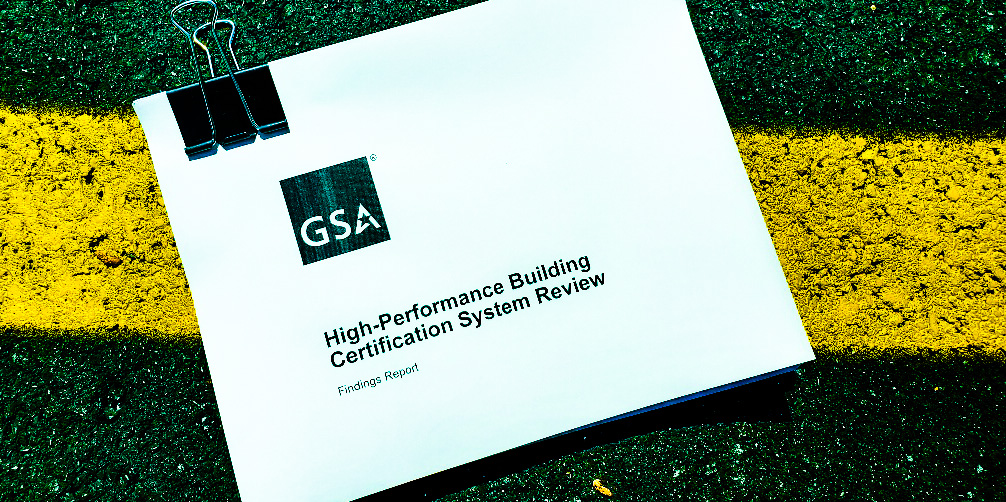
GSA Reviews more than 100 Green Building Systems and Recommends 5
Section 436(h) of the Energy Independence and Security Act of 2007 requires the General Services Administration’s Office of Federal High-Performance Buildings to complete a review of high performance building certification systems every 5 years. After the review, GSA recommends to the Secretary of Energy the building certification systems most likely to encourage a comprehensive approach to certification of high-performance buildings.
The last review, in 2012, shook the green building industrial complex to its foundations, when it not only recommended LEED (that had previously been the sole option), but also recommended Green Globes.
GSA is now undertaking the next 5 year review and last week released a draft report of its recommendations.
GSA researched the U.S. market and identified more than 100 whole building certification systems. The screening next identified 6 systems that likely met the government’s requirements for its own building (one system, Earth Advantage, declined to participate):
BOMA BEST Sustainable Buildings, version 3.0
BREEAM In-Use USA, version 2016
Green Globes, version 2013
LEED, version 4.0
Living Building Challenge, version 3.1
GSA invited those system owners to complete a survey, which asked for information on the technical components of the certification system that address federal high performance building requirements and industry best practice, as well as the processes by which the system was created. GSA evaluated the effectiveness and conformance based on specific building requirements found in:
The Green Building Certification Systems Requirement for New Federal Buildings and Major Renovations of Federal Buildings Final DOE Rule,
EISA, and
The 2016 Guiding Principles for Sustainable Federal Buildings.
GSA, actually a third party consultant engaged by an unrelated government agency whose work was vetted by yet another consultant, evaluated 39 criteria for new construction and building interior systems and 36 criteria for existing buildings systems. The GSA report concludes,
While each system reviewed for this report addresses the primary criteria that define high-performance buildings, no single system fully ensures conformance with all the federal requirements. Each system offers a unique framework and approach to achieving building certification, but all the systems generally agree on the aspects of building design, construction, operation, and maintenance that lead to high-performing commercial office buildings.
Specifically, the GSA report finds that for “new construction and major renovation” LEED BD+C and Green Globes NC score identically, both slightly ahead of the score for LBC.
For “existing building” certification systems the GSA report scores all well ranking in descending order LEED O&M, Green Globes EB, LBC EB, BREEAM, and BOMA.
And for “building interior” the report ranks LBC Interiors best followed by LEED ID+C and then Green Globes Interiors.
Of course there is no requirement that federal agencies use green building certification systems, although agencies may choose to do so to support conformance with federal high performance building requirements in statutes and executive orders, as well as the Guiding Principles for Sustainable Federal Buildings. However, the use of building certification systems has advantages for federal agencies and it can be anticipated that the list of recommended building certification systems in 2019 will include all those reviewed. The trend nationally is for government to branch out from the days of old LEED only, allowing any of a variety of green building programs, as Maryland is expected to do next month.
All of that observed, the efficacy of this report may be short lived. There is serious discussion in several Executive Branch departments to next year eliminate most if not all of the high performance building requirements from the best practices and guidance issued by GSA for application federal government wide.
About the Author: Stuart Kaplow