View by Topic
Recent Articles
-
 TMDL Trump Executive Order – Why the Chesapeake Bay “Pollution Diet” Remains IntactSaturday, October 3rd, 2026
 -
 Maryland’s Packaging EPR Program Moves From Law to RealitySaturday, September 26th, 2026
 -
 Exposomics – The New Environmental Risk You Have Not Heard AboutSaturday, September 19th, 2026
 -
 Clean Water Isn’t a Constitutional Right? Fifth Circuit Says NoSaturday, September 12th, 2026
 -
 The Air We Breathe – Indoor Air Quality Is Becoming a Real Estate IssueSaturday, September 5th, 2026
View by Month/Year
“Green Building Law Update” Headlines
Recent Articles & News from
Stuart Kaplow’s blog
at GreenBuildingLawUpdate.com
Subscribe to the Green Building Law Update!
Stuart Kaplow brings his expertise and extensive experience to the table with his unique digital publication, "Green Building Law Update". Subscribers receive regular updates to keep them informed about important issues surrounding Environmental Law, Green Building & Real Estate Law, as well as the emerging demand for Environmental Social Governance (ESG).
Get fresh content through the lense of Stuart Kaplow's cutting-edge expertise, innovative commentary and insider perspective. Don't miss another issue! Subscribe below.
Buying a LEED Certified Building Is Easy But ..
Despite that a frog told us all in a song lyric, “it’s not easy bein’ green,” it is easy to buy a green building, but ..
And there are many good reasons for purchasing a green building that is LEED Certified. LEED gave us the technologies and methodologies revolutionizing the way we construct and occupy buildings. And while there is no debate that a LEED Certified building has a higher return on investment than a comparable nongreen structure, the certification in and of itself may be of particular import for a building that benefits from a government incentive arising from LEED certification or for a building advantaged by a contractual arrangement requiring it be LEED Certified.
Today when there are more 95,600 LEED Certified projects, with many of them among the most desirable buildings in their respective market, those innovative buildings are regularly being bought and sold. In fact we know from the proprietary data of a commercial real estate information company that LEED Certified buildings are being conveyed at a faster pace than the broader commercial real estate market.
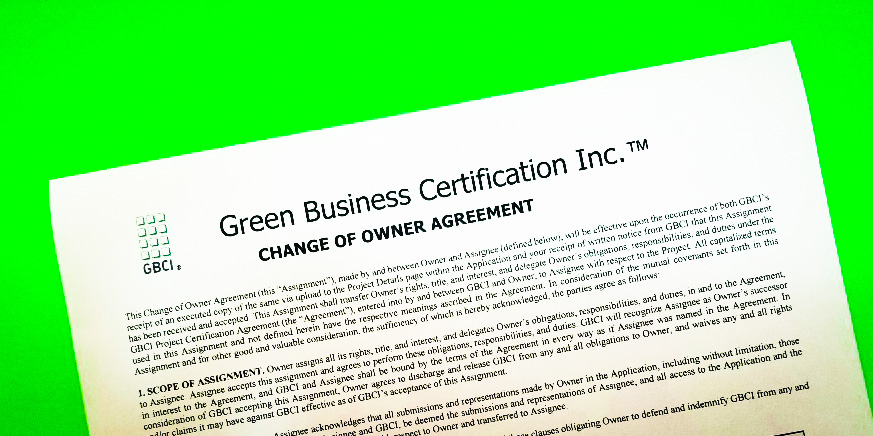
That being the case, then why has the GBCI Change Of Owner Agreement been uploaded into LEED Online only 700 times since February 2015?
“Recognizing that the ownership of buildings frequently changes, GBCI created the change of owner form in order to be able to update its directory and to honor the current owners of GBCI-certified projects. The form can be used to indicate the change of ownership for any projects certified by GBCI, including LEED, SITES, and PEER,”
according to Susan Dorn, the General Counsel of USGBC and GBCI.
So, GBCI even provides a form, making affecting the change in their system easy, but the Change of Owner Agreement form is little used. Is it possible, “what we’ve got here is failure to communicate” similar to the plight of Paul Newman in the 1967 movie classic Cool Hand Luke? Is it possible that real estate professionals are flouting care and caution and do not know the form exists?
The standard of care today has evolved such that in a contract of sale for a commercial building that is LEED Certified, the due diligence materials provided by the seller to the purchaser must include access to the LEED Online project registration or a copy of the entire LEED Online project file (that can be downloaded).
Additionally, the contract will include representations and warranties describing that the building is LEED Certified under a particular rating system (e.g., LEED New Construction v2009 Silver Certified), include the “project name” used in the GBCI application as well as the GBCI ID Number.
Moreover, within the representations and warranties about contractual obligations that will survive closing may properly be something like, “To satisfy the LEED NC v4 EAc7: Green Power and Carbon Offsets credit, the building has entered into a contract for qualified resources that have come online since January 1, 2005, for a minimum of five years, to be delivered at least annually. A copy of the contract, which is attached in Exhibit __ specifies the provision of 100% of the project’s energy from green power, carbon offsets, or renewable energy certificates (RECs).”
And there are other obligations associated with LEED that may survive closing (e.g., the credit indoor chemical and pollutant source control, the obligation to submit energy and water consumption data to USGBC, etc.), but this law firm regularly reviews contracts of sale that fail to make any such disclosures. More than 39% of LEED NC 2009 projects have achieved the Green Power credit, arguably the most common rating system for a building being sold this year, but we know anecdotally the obligation is rarely disclosed in a contract of sale; something potentially imposing post closing liability on the seller.
Finally, a contract of sale should list as a document to be delivered at closing (.. but arguably most do not), in addition to a warranty deed, originals of all leases and the like, “a GBCI Change of Owner Agreement completed and executed by the seller.”
But assuming none of that happens, yet someone acquires a LEED Certified building and desires to pursue recertification or even just be correctly listed in the LEED Project Directory, GBCI will have your back, as Susan Dorn explains,
“We are also aware that it’s not always possible to obtain the signature of the initial owner after a period of time has passed. In such circumstances, GBCI legal works with the current owners to find ways they can demonstrate their ownership interest [a copy of a deed]. USGBC and GBCI want to celebrate, with the current owners, their pride and value in their LEED certified buildings.”
From time to time this firm is asked to provide an “opinion of counsel” that a LEED Certified building is really a LEED Certified building and while we do provide legal opinions such is more common as a condition of a lender for financing, including often in a lender program offering a discounted interest rate for green building.
Purchasing a LEED Certified building, or a project certified under any of the GBCI rating systems, is easy, but in this new and emergent field of green building, there are now resultant accepted legal niceties, including delivery of a GBCI Change of Owner Agreement, that are necessary and proper between seller and buyer.
About the Author: Stuart Kaplow