View by Topic
Recent Articles
-
 The Lead Paint Legacy Real Estate Owners Must Take SeriouslySaturday, August 22nd, 2026
 -

-
 Puerto Rico’s Water Crisis – The Era of Potable Water Bankruptcy Has ArrivedSaturday, August 8th, 2026
 -
 Commercial Space Launch Reform – FAA Proposal Will Cut Years from Licensing ApprovalsSaturday, August 1st, 2026
 -
 Radon – Test and Decide for YourselfSaturday, July 25th, 2026
View by Month/Year
“Green Building Law Update” Headlines
Recent Articles & News from
Stuart Kaplow’s blog
at GreenBuildingLawUpdate.com
Subscribe to the Green Building Law Update!
Stuart Kaplow brings his expertise and extensive experience to the table with his unique digital publication, "Green Building Law Update". Subscribers receive regular updates to keep them informed about important issues surrounding Environmental Law, Green Building & Real Estate Law, as well as the emerging demand for Environmental Social Governance (ESG).
Get fresh content through the lense of Stuart Kaplow's cutting-edge expertise, innovative commentary and insider perspective. Don't miss another issue! Subscribe below.
Local Laws Stop the Setting Sun on Solar Installations
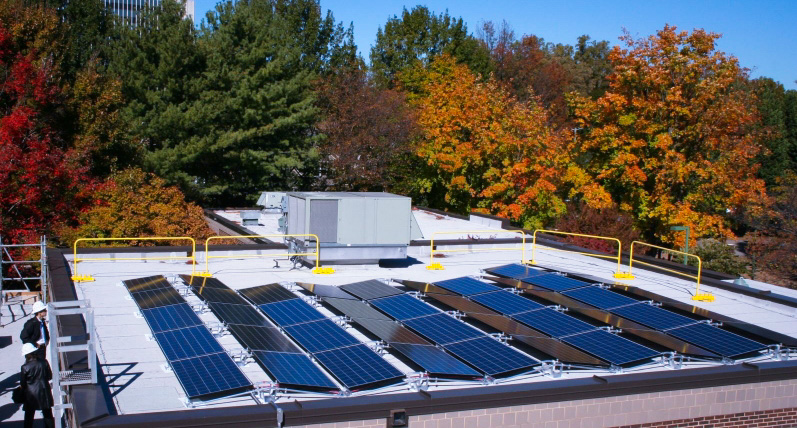
Two bills pending in the Montgomery County Council aim to increase the use of renewable energy in the suburban Maryland County.
At a time when the number of households installing solar panels on their roofs declined last year, the first annual decline since 2000, and a decline by more than 15% when compared with the year before, following 5 years of growth that averaged nearly 50% a year, many believe that the growth of onsite renewable energy is not sustainable in the current environment.
These two bills are models, replicable across the country, for promoting more solar installations.
Bill 12-18, Real Property – New Home Sales Contracts – Solar Panel Systems, sponsored by Councilmembers Marc Elrich and Tom Hucker, was introduced on March 20, 2018 and a public hearing is scheduled for this week on April 10.
Bill 12-18 would require the seller of a newly constructed single-family home to give the buyer an option to install a solar panel system. It would also require the seller to disclose the benefits of a solar panel system and an estimate of the cost to install the system.
The stated purpose of the bill is to increase the use of renewable energy in the County. The bill would encourage this by ensuring that the purchaser of a new single-family home or townhouse (i.e., a house not previously sold or occupied) is aware of the option of installing solar panels on the roof of the home including receiving an estimate of the cost to install the panels before signing a contract of sale. The buyer would have the option of either adding the installation of solar panels to the new home sale contract or declining to add the panels.
Forms required to implement the new law and to be included with contracts of sale for newly constructed homes, included the required costs estimates, are to be provided on the County website. Numbers made available by the federal government depict that the cost of a typical rooftop solar installation fell more than 60% between 2010 and 2017 to $2.80 per watt or roughly $16,000 for the average home.
And the second proposed enactment, Bill 11-18, Buildings – Environmental Roof Design – Non – Residential and Multi-family buildings, also sponsored by Councilmember Elrich, was also introduced on March 20 with a public hearing scheduled for April 10.
Bill 11-18 would require an environmentally sustainable roof on certain new and extensively modified non-residential or multi-family buildings.
This bill would require new non-residential and multi-family buildings that will have at least 10,000 square feet of floor area to have a solar roof with at least 15% of the roof surface covered by solar thermal collectors or a solar photovoltaic system, as prescribed by section 408.3 of the International Green Construction Code. If that is not practical (because the roof is in the shade of a neighboring building for example), then if not solar, a vegetative green roof is required, if practical. If neither solar nor vegetative, then a heat reducing reflective roof must be installed.
It would also authorize the Director of the Department of Permitting Services to approve a full or partial waiver.
The solar industry has retreated both because of market forces, including overly aggressive sales tactics and saturation among early innovator home owners, both that could not be propped up by federal government tax incentives that principally benefitted institutional investors. New U.S. tariffs will only result in that market being more constrained in 2018.
These two bills are models, replicable across the country, for promoting onsite renewable energy.
About the Author: Stuart Kaplow